
After the covid-years, that I mainly spent quietly with my wife and our beloved Bernese Mountain dog, Mr Felix, on San Juan Island — thinking, working, running, writing — I’m back!
I’ve stepped down from all executive duties at the Allen Institute, returning to being a regular scientist at the Allen Institute in Seattle (my formal title is Meritorious Investigator). I remain the Chief Scientist of the Tiny Blue Dot Foundation in Santa Monica. And, most importantly for this blog, my next book is out.

Then I am Myself the World – What Consciousness Is and How to Expand, is my fourth book on the neuroscience, psychology, pharmacology, philosophy, and the lived experience of consciousness that I’ve written within two decades. Why do I feel compelled to write a book every five years on this elusive topic?
Because so many new and exciting developments are happening in this space!
First and foremost, my own encounter with two extraordinary conscious experiences. One in the opening days of the pandemic that took away my fear of death; during a second experience I encountered what Aldous Huxley in The Doors of Perception described as Mind-at-large. This triggered a seismic shift in the ontological grounds I’ve lived on for most of my life. Then there are myriad of relevant scientific findings pertaining to tracking down the footprints of consciousness in the brains of humans and other mammals; with a team of clinicians-physicians, I’ve started a company, Intrinsic Powers, to build a device and bring it to clinical practice to detect the presence of consciousness in brain-injured patients unable to signal; a scientific theory of consciousness, the integrated information theory (IIT), developed and refined over the past two decades, that can now not only explicate which systems are conscious and by how much but can also describes the qualitative aspects of any one experience – whether this is felt space, time flowing or seeing colored objects; the philosophical grounds have shifted from a blind acceptance of classical physicalism (aka materialism) to encompass much more diverse, and more ancient, viewpoints, such as panpsychism and idealism; mystical-, near-death, and psychedelic-induced experiences are now taken seriously within the academe and analyzed with scientific tools and I needed to describe these developments and their transformational potential; finally, the question of computer consciousness has taken on urgency – according to IIT, consciousness is neither a computation nor a process; while digital computers will soon be able to do everything we can do, they can never be what we are, conscious! It will never feel like anything to be a large language model.
Read the opening chapter of Then I am Myself the World, with its depiction of my near-death-experience, and its table of content.
Simultaneously, I’m a co-author on a paper with my friend Hartmut Neven, the quantum physicist who leads Google’s Quantum Computing group, and a few other colleagues, that will be published in the peer-reviewed journal Entropy (here is an earlier preprint). The manuscript, entitled “Testing the conjecture that quantum processes create conscious experience” links the establishment of superimposed and entangled states of matter to consciousness (related to, but opposite from the proposal by Roger Penrose and Stuart Hameroff that the collapse of superposition results in a conscious moment). Our proposal is firmly rooted in Everett’s “many worlds” formulation of quantum mechanics. We assume that a system only ever experiences classical, definite states. Quantum mechanics is quite congenial to the Integrated Information Theory (IIT) of consciousness, in particular to its exclusion axiom, that every conscious experience is definite. Furthermore, quantum entanglement would easily solve the binding problem, that is the unity of phenomenal experience (the integration axiom within IIT).
Our paper discusses certain ways in which some of these ideas could be tested, among other by coherently coupling an external quantum device to the brain. Together with my co-authors, we are now embarking on experiments in fruit flies and in cerebral organoids, that, if they come to a successful conclusion would make it much more plausible that quantum mechanical effects would be of relevance to the actions of the nervous system in a non-trivial manner.
Given everything I know about wet and warm brains, our proposal is unlikely to be true but everything not explicitly forbidden by physics, could potentially be exploited by natural selection! And the beauty of science is that it allows us to ask Nature a question. And sometimes you get a very surprising answer…
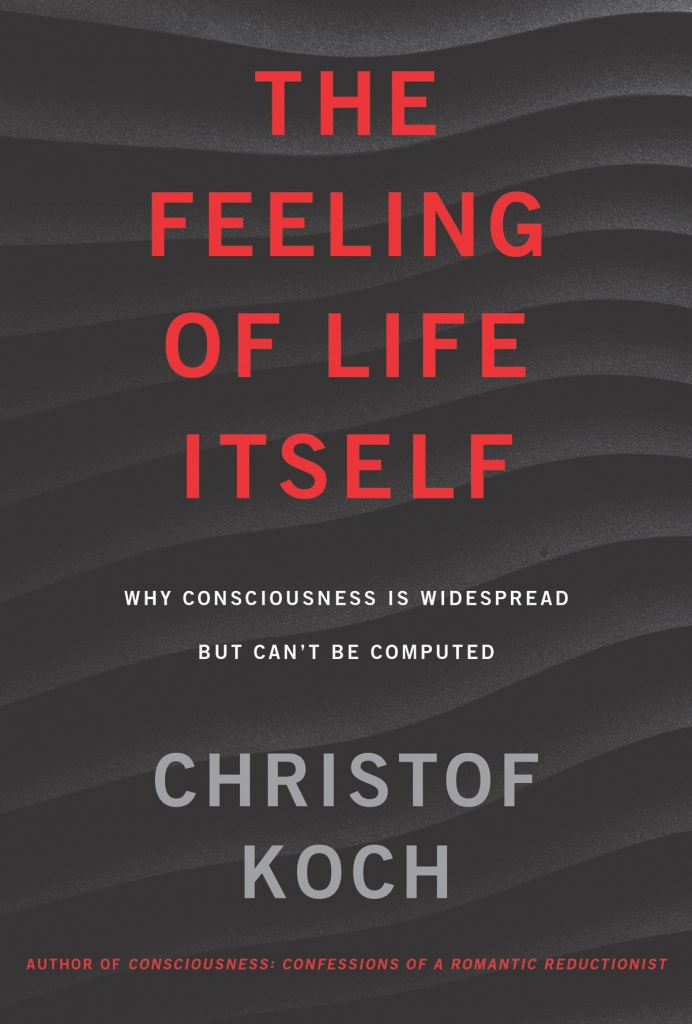
My previous book was The Feeling of Life Itself – Why Consciousness is Everywhere But Can’t be Computed. If you wonder how and where the sounds and sights in the skull-sized infinite kingdom that is your mind come from, who else has these feelings and whether computers can ever be conscious, this is the book for you.
For more than a decade, I was the Chief Scientist and, then, the President of the Allen Institute for Brain Science in Seattle in the Pacific Northwest. My passion in life to understand how I came to be in this wonderful, mysterious universe. Not so much me, personally, but me as a conscious, experiencing organism, surrounded by other people, dogs, trees, stars, and the sea.
At the professional level, I seek to understand how the cortex that makes up the crown of the brain, the most complex tissue of active matter in the known universe, gives rise to any conscious experience – to the feeling of love, melancholy, pain or pleasure. This is the heart of the ancient mind-body problem.
My other research interests include elucidating the biophysical mechanisms underlying extracellular electric fields, the computations carried out by cortical neurons, clarifying the structure and function of the claustrum, a thin layer of neurons underneath cortex to which it is strongly and reciprocally connected, and using integrated information theory to study consciousness in brains and machines.
I’m one of seven billion random deals from the deck of human possibilities—I grew up happily, lived in many cities in America, Africa, Europe, and Asia, a physicist turned neurobiologist. From 1986 until 2013, I was a Professor of Biology and Engineering at the California Institute of Technology in Southern California.
For the sake of animals, I’m a vegetarian, eyeing veganism.
For the sake of the planet, I’m a full-time cyclist. I haven’t owned a car in a long while
I have a soft spot for philosophy, classical music and a great love for books, big boisterous dogs, vigorous and sustained physical activity, the outdoors, and a sense of melancholy, living in the twilight of a glorious age.
Stemming in part from a long-standing collaboration with my mentor and close colleague, the late Nobel Laureate Francis Crick, I wrote Consciousness: Confessions of a Romantic Reductionist. This pithy 2011 book blends science and memoir to explore topics in the science of consciousness.
I also wrote two more technical textbooks – The Quest for Consciousness: A Neurobiological Approach back in 2004 and my first book, the quite technical Biophysics of Computation: Information Processing in Single Neurons, back in 1999.
 The Passions of Christof Koch